
Certificates of analysis are the backbone of consumer safety in the cannabis industry. But these lab reports are often filled with scientific abbreviations and jargon, which doesn’t make them easy to read.
In this blog, we’ll break down exactly how to read a COA, what each section means, and how to use these lab results to better tailor your cannabis consumption, using a real COA from our Black Mamba AiroPod sold in Maryland.

What is a COA?
COA stands for certificate of analysis. A COA is the result of safety tests run by a licensed, third-party lab for a given cannabis product. A COA proves that:
- A product is safe to consume
- The contents of a product match what the labels say
In addition, the COA gives you information about the lab that did the testing, the brand that submitted the product, and the product in question. Lab testing is a major piece of consumer safety in the medical and recreational cannabis markets so you know that your products are safe for consumption.
Why Do I Need Cannabis COAs?
COAs give you more insight into your cannabis products. The main purpose of lab testing is to ensure your safety when consuming cannabis products, but you can also use a COA to better understand your nuanced cannabis preferences.
What’s in a COA?
Exactly what information your COA contains depends completely on which state you buy cannabis products in. In general, a COA will include:
- Product information – the brand name and product type
- Contact information for the lab
- The date and batch number of testing, which should match the batch number on your vape or edibles.
- Summary of the test results
- Detailed results for heavy metals, pesticides, microbes, and residual solvents
- Cannabinoid profile of the product
The exact contents of the COA depend on the state and the brand. Some brands only test for the required bare minimum while others go above and beyond to include information on the terpene profile, minor cannabinoids, and even compounds like flavonoids.
How to Read a COA
The format of a COA changes from state to state and lab to lab. But most of the categories stay the same, and once you understand what you’re looking for, it becomes much easier to scan for.
Understanding COA terms
- The analyte column tells you what compound the lab is testing for.
- LOQ stands for limit of quantitation, the smallest amount of a substance that would be detectable on the test
- Mass appears in two ways: by percentage and milligrams per gram. These columns tell you the same information in different ways: the amount of the tested analyte that appeared in the product.
- The Action Limit is the legal limit of a compound that is allowed in a given product.
- UOM stands for unit of measurement, telling you how an analyte is measured.
There are several sections to a COA
- Header
- Results summary
- Potency and Terpenes
- Safety Profile
- Footer
Header
This is where you’ll find brand information, product information, and lab information.
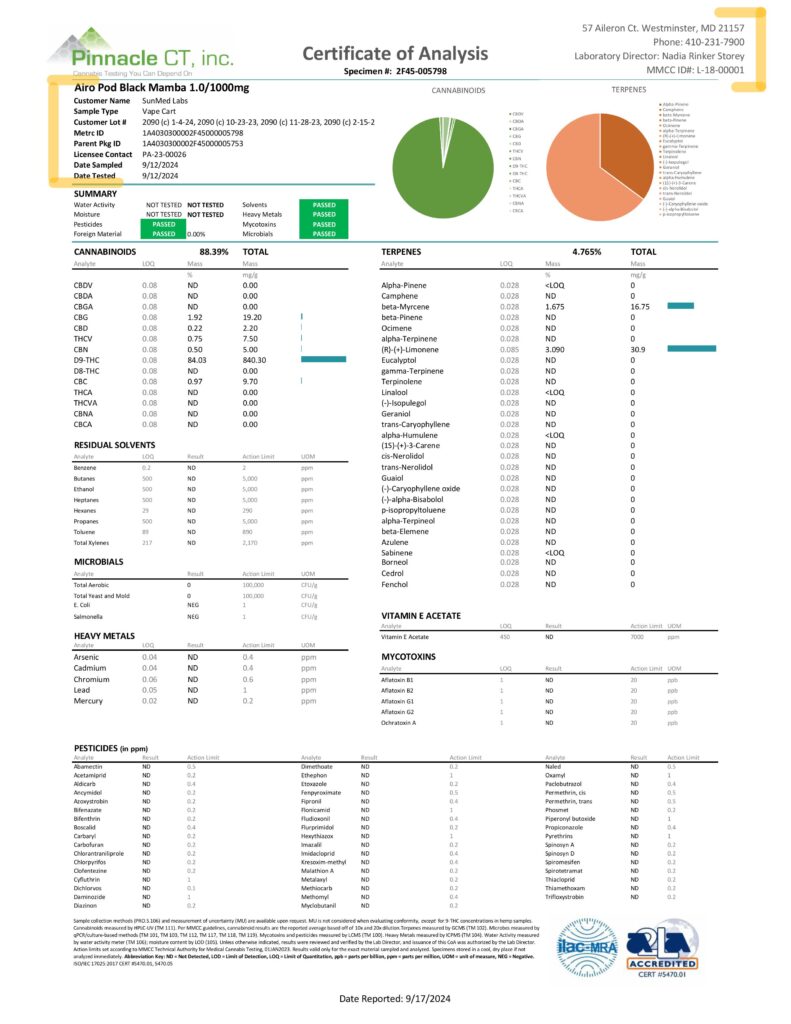
Results summary
A brief summary of the contents of the COA. You always want to see “passed” for the testing here – a product that fails any tests should not be sold. This COA also includes a robust summary of the cannabinoid and terpene profile, which may vary from state to state.
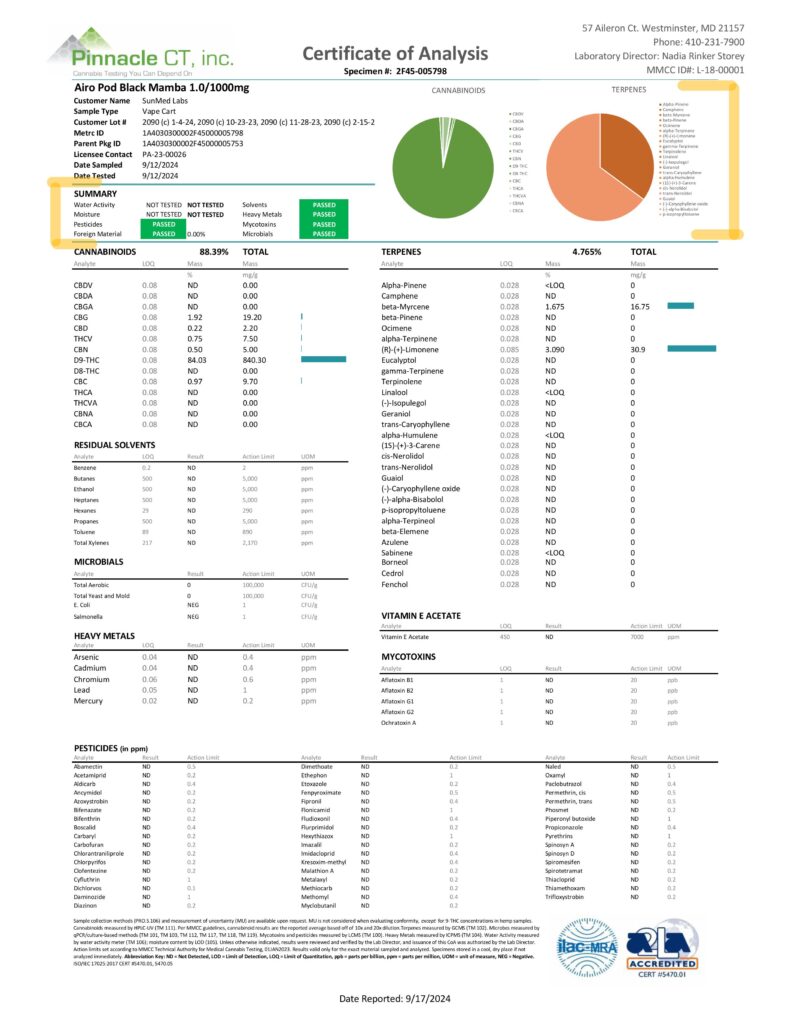
Potency and Terpenes
In this section, you’ll find important information on the contents of your product. As you can see, this vape has mostly THC, with a small amount of other cannabinoids: CBG, CBD, CBN, THCV, and CBC.
Our Black Mamba vape is dominant in two terpenes: myrcene and limonene. You’ll also notice two different answers under the “Mass” section for the terpenes: ND and <LOQ. The terpenes marked “ND” were not detected at all. The terpenes marked “<LOQ” were not in large enough quantities to be measured in the test.
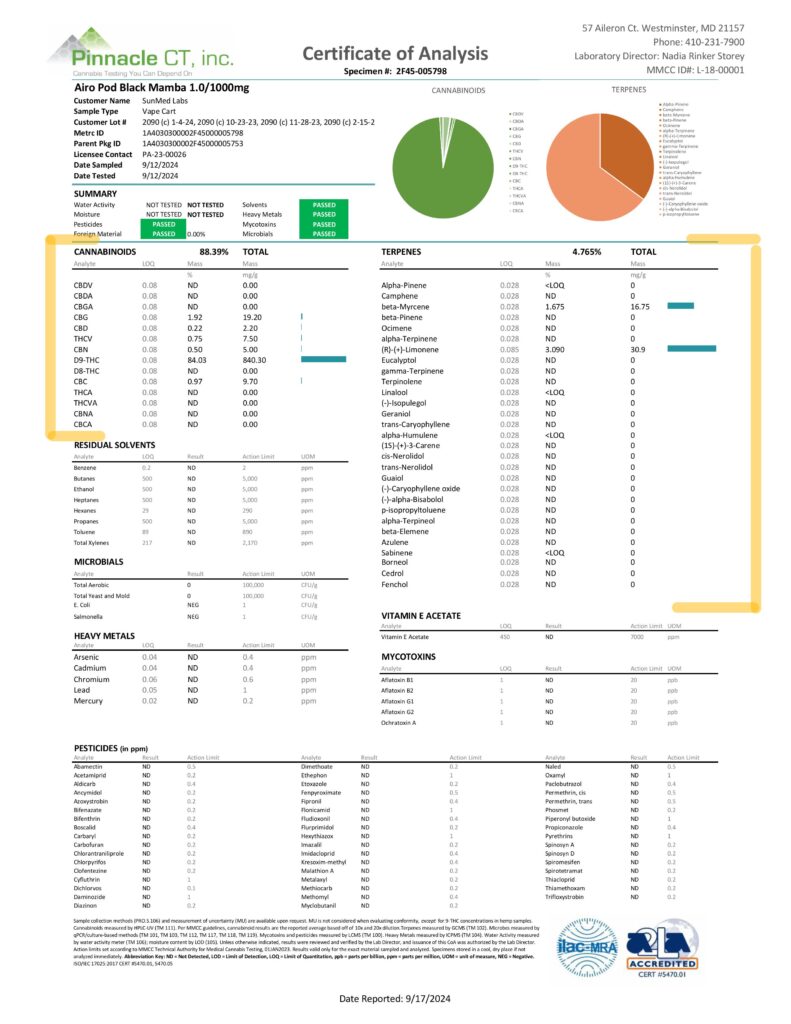
Examining the COA can give you great insight into the makeup of your cannabis products, and help you better understand your unique preferences. Some people love limonene for its energizing qualities while others find it too stimulating. Some cannabis consumers seek out myrcene-heavy strains while others look for more unusual terpenes like terpinolene and eucalyptol.
Terpenes play an important role in the entourage effect of a product, and understanding which terpenes work well for you can help you better tailor your cannabis consumption to your goals.
Safety Profile
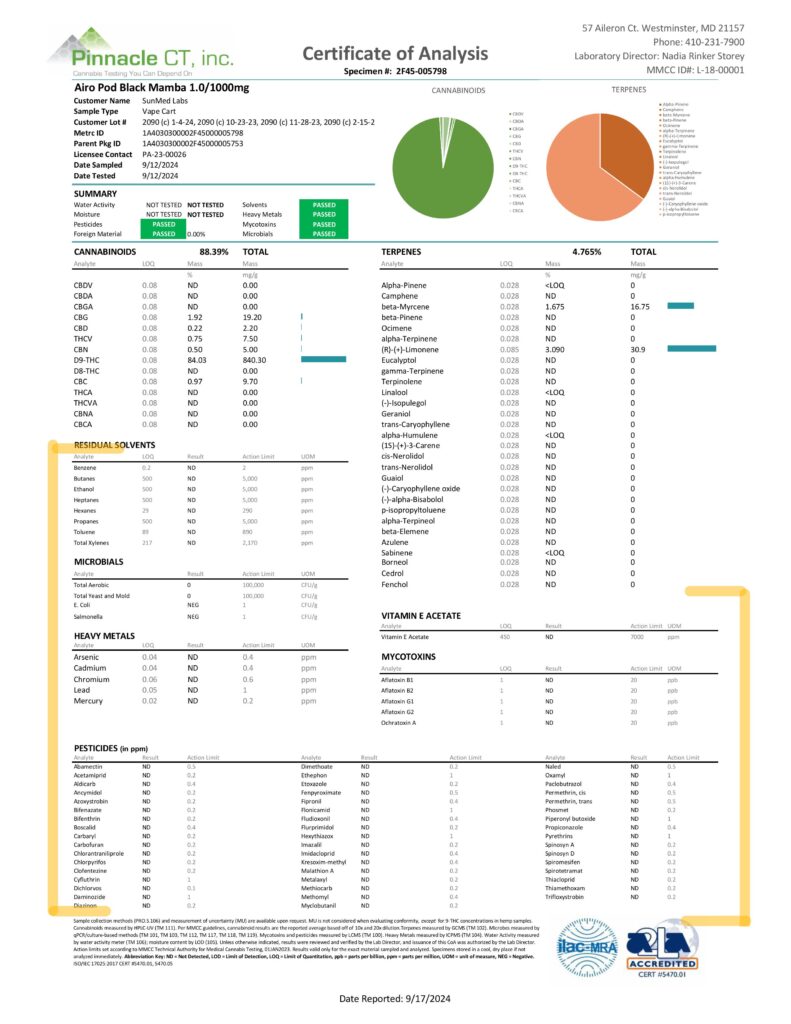
The safety section is a critically important part of a COA, because it proves that your cannabis product is safe to consume. Typically, safety tests look for the following:
- Pesticides
- Residual solvents (concentrates and extracts only)
- Heavy metals
- Microbials
- Mycotoxins
Every state has limits on acceptable levels of pesticides, heavy metals, microbes, mycotoxins, and residual solvents. To pass lab testing, a product must fall under the legal limit for these substances. Some states may require the limit to be included in the COA. The only thing you want to see under these sections is “ND” which stands for not detected – no traces of any pesticide, heavy metals, microbes, or residual solvents. You may also see “<LOQ” which means the compound in question did not appear in a high enough concentration to be measured. No cannabis product that has failed a safety test should ever be sold to consumers.
Residual solvents and testing for vitamin E acetate are especially important for vape cartridges – and you want to see “ND” on your COA to know that these products are safe.
Footer
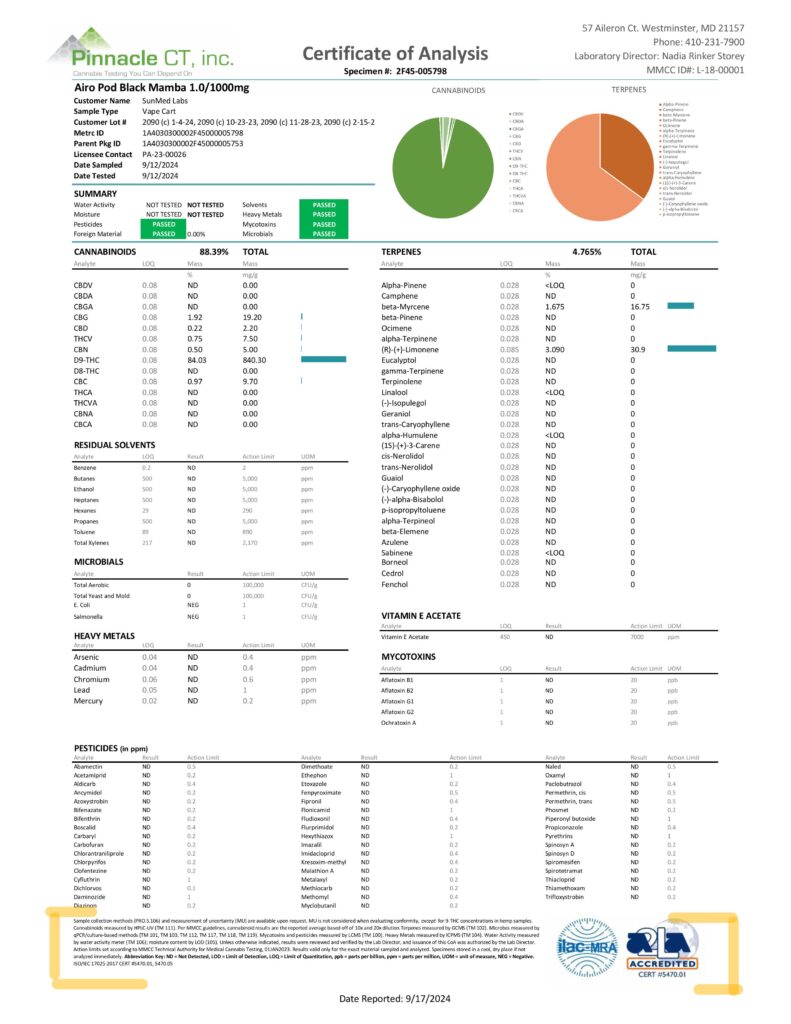
At the very bottom of the COA you’ll find more information about the testing methods and the qualifications of the lab used.
Cannabis labs must be ISO/IEC 17025 accredited, a certification that allows them to do analytical testing on cannabis and cannabis-derived products. The “Cert #” at the bottom of the COA gives you the lab’s certification number, which you can look up to confirm their accreditation.
How to find Airo’s COAs
All of our COAs are accessible by scanning the QR code that comes printed or stickered to your Airo vapes or edibles package. Scanning it will take you directly to the lab results of the testing on your product. Airo makes it easy for you to access COAs on all of your products, no matter where in the United States you bought them.
If a company makes you jump through hoops to find their COAs or does not make them available to the public, that is a huge red flag. Reputable, trust-worthy cannabis brands have nothing to hide in their COAs, and proudly share them with consumers like you to prove that their products are safe.
Certificates of analysis are an important part of ensuring consumer safety with cannabis products. Learning how to read these analyses helps ensure your products are safe and can even give you insight into your product preferences. Have questions about your COA or Airo product? Feel free to reach out to Airo – we’re here to help.